UK faces more than £20bn hit from steeper productivity downgrade, fuelling tax rise speculation – business live | Business
Reeves faces £20bn-plus hit from UK productivity cut
Here’s our full story: Rachel Reeves will have to account for a bigger-than-expected £20bn hit to the public finances in next month’s budget, the Guardian understands, as the Treasury’s forecaster prepares to cut predictions for UK productivity.
The Office for Budget Responsibility (OBR) is planning to cut its trend productivity growth prediction by 0.3 percentage points, in a move that increases the likelihood of the chancellor announcing tax rises on 26 November.
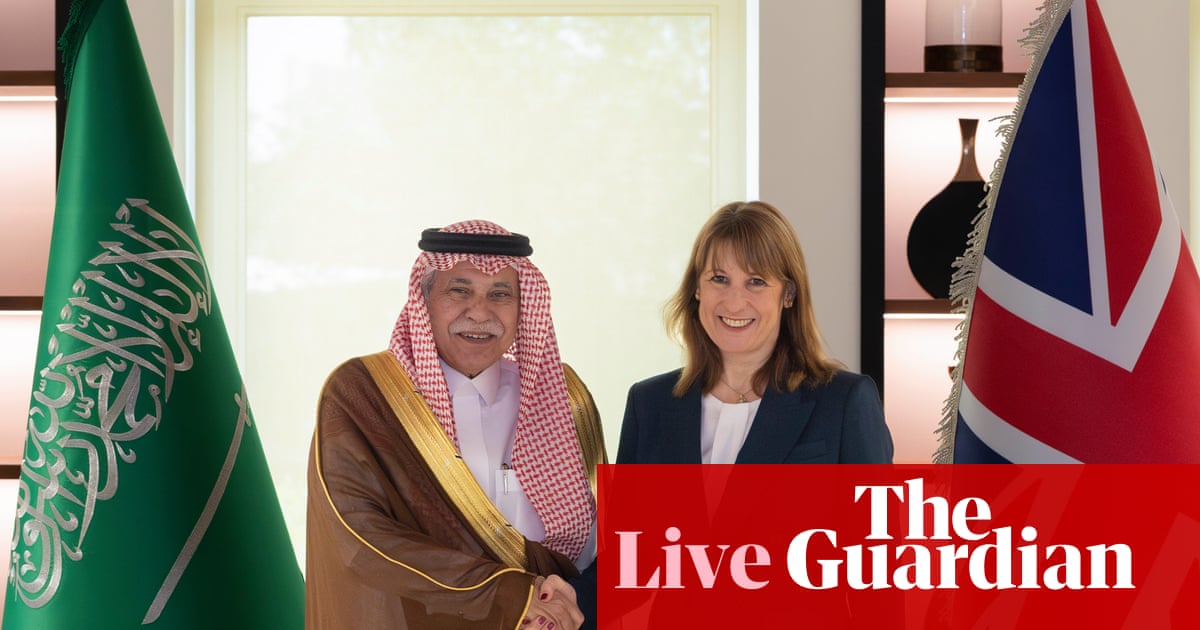
Reeves told the Fortune Forum in Saudi Arabia on Monday:
Our independent forecaster is likely to downgrade the forecast for productivity in the UK based not on anything this government has done, but on our past productivity numbers, which, to be honest, since the financial crisis and Brexit have been very poor, and that just shows how essential growth is.
So I’m not going to do anything in the budget that reduces our opportunities to grow the economy. That’s very important.
The estimated impact is based on calculations by the Institute for Fiscal Studies (IFS) thinktank, first reported in the Financial Times, which has said that each 0.1-percentage-point downgrade to productivity would increase public sector net borrowing by £7bn in 2029-30. That suggests that a 0.3-point reduction could result in a £21bn hit to the public finances.
Some analysts had been forecasting a 0.1 to 0.2-point downgrade in the OBR’s productivity outlook, resulting in smaller hit to the public finances of between £7bn and £14bn, based on IFS calculations. This would result in a total fiscal hole of £20bn to £30bn, according to some estimates.
A larger downgrade to productivity by the OBR would increase that shortfall. However, the final number could be offset by other factors including lower borrowing costs and faster-than-expected growth.
Key events
Britain’s second-biggest drugmaker GSK has struck another deal to bolster its pipeline of medicines, a day before announcing its quarterly results, the last presented by outgoing chief executive Emma Walmsley.
The company has acquired a treatment for COPD, a severe lung disease, that is in early clinical studies, from the Californian biotech Empirico.
GSK said the drug’s novel mechanism of action, discovered by Empirico, targets a distinct inflammatory pathway introducing the potential for a therapeutic approach that is agnostic of baseline type 2 inflammation, smoking or co-morbid disease. The target is backed by extensive genetic data.
Kaivan Khavandi, global head of respiratory, immunology & inflammation research & development at GSK, said:
This agreement reflects our ambition to transform care in COPD by advancing novel targets, backed by data, to address underlying drivers of disease. With its expected long-acting characteristics and ability to target distinct inflammatory pathways, EMP-012 complements our pipeline of diverse modalities in COPD and builds on the current landscape of inhaled and biologic therapeutics in this area of substantial unmet need.
GSK will pay $85m upfront and up to $660m in success-based development, regulatory and commercial milestones, as well as tiered royalties on sales worldwide.
Yesterday, GSK struck a deal for a prostate cancer medication from a French biotech firm.
Separately, the pharma firm’s treatment for small-cell lung cancer has received orphan drug designation in the EU, as it addresses a significant unmet need for an aggressive form of lung cancer with poor outcomes and limited treatment options, GSK said. The status, awarded to medicines for rare conditions, means the drug can benefit from incentives such as protection from competition once on the market.
Shrinkflation hits everyday staples, piling more pressure on households
Toothpaste, coffee and even heartburn medicine are among the latest products quietly shrinking in size while shoppers pay the same price, piling more pressure on household grocery budgets.
Consumer watchdog Which? found a range of new examples of shrinkflation as brands cut back on quantity and quality in an effort to reduce their own costs.
One of the worst instances was Aquafresh complete care original toothpaste, which went from £1.30 for 100ml to £2 for 75ml at Tesco, Sainsbury’s and Ocado – a 105% increase per 100ml.
Haleon Great Britain and Ireland, which was spun off from GSK three years ago and owns the Aquafresh brand, told the Guardian:
We understand that people across the UK are facing pressure on their finances. Prices go up and down for a variety of reasons, and we always work hard for people to receive the highest quality products at the lowest price so that the whole family can take care of their teeth.
Gaviscon heartburn and indigestion liquid shrank from 600ml to 500ml, with Sainsbury’s keeping the price at £14 – equivalent to a 20% increase per 100ml. They did not respond to a request for comment.
Nescafé original instant coffee was cut from 200g to 190g at Tesco, Morrisons and Asda – about a 5% rise per 100g. A Nestlé spokesperson said:
Like every manufacturer, we have seen significant increases in the cost of coffee, making it much more expensive to manufacture our products … Retail pricing is always at the discretion of individual retailers.
Chocolate has also been hit by rising cocoa prices, with Quality Street tubs reduced from 600g to 550g and prices at Morrisons increasing from £6 to £7 – a 27% rise per 100g. Club and Penguin biscuits, both made by McVitie’s, can no longer be described as chocolate biscuits, as they now contain more palm oil and shea oil than cocoa, a change first reported by trade journal The Grocer.
TUC warns 2m workers at risk from unfair dismissal if six-month qualifying period introduced
The TUC has warned that more than 2 million workers would be denied protection from unfair dismissal if a six-month qualifying period was implemented before those rights kick in.
The employment rights bill is designed to ensure workers are protected from being sacked unfairly from day one in the job. It will also ban exploitative zero-hours contracts by giving workers a right to a contract which reflects their regular hours.
But it is being delayed by a series of amendments by Tory and Lib Dem peers, including one that would provide a loophole for workers to be denied a guaranteed hours contract and another that would introduce a qualifying period of 6 months for protection from unfair sackings.
TUC general secretary Paul Nowak said Lords blocking the Bill should “step aside” so government can deliver its flagship workers’ rights bill that will improve the lives of millions of workers – a key manifesto commitment at the last election.
The TUC warns some in the business community – and on the opposition benches – are “willfully misrepresenting” the policy, and says employers can still have probation periods for staff, but they just won’t be able to sack staff unfairly.
UK’s Eastern Airways to go into administration, with all flights cancelled
The UK domestic airline Eastern Airways has suspended operations and all of its flights have been cancelled, as it teetered on the brink administration, putting jobs at risk. The move affects hundreds of thousands of passengers.
Customers of the airline, which operated regional services from airports across the UK, are urged not to go to the airport as flights will not be operating, the UK Civil Aviation Authority said.
The airline served different destinations in England and Scotland, including Aberdeen, Humberside, Gatwick, Newquay, Teesside International and Wick John O’Groats, according to its website.
On Monday morning the company filed a notice of intention to appoint an administrator at the insolvency and companies court within the high court.
Selina Chadha, consumer and markets director at the UK Civil Aviation Authority, said:
We urge passengers planning to fly with this airline not to go to the airport as all Eastern Airways flights are cancelled.
Eastern Airways customers should visit the Civil Aviation Authority’s website for the latest information.
HSBC profits fall 14% amid hit from Hong Kong property downturn and Madoff provision

Kalyeena Makortoff
Here’s more on HSBC.
HSBC has reported a 14% drop in third quarter profits to $7.3bn (£5.5bn), as it took a dual hit from both a real estate downturn in Hong Kong, and a lawsuit over the Bernard Madoff ponzi scheme.
It came as the London-based bank reported a 24% jump in operating costs to $10.1bn, which included restructuring costs – severance for bankers let go as part of the process – linked to a major shake-up under chief executive Georges Elhedery announced last year.
But those operating costs also reflected a $1.1bn provision to cover a lawsuit by investors who lost money in the Madoff ponzi scheme. It comes after a Luxembourg court turned down HSBC’s appeal.
Madoff admitted in 2009 to defrauding thousands of investors, losing them $65bn (£48.8bn). He died in prison in 2021. HSBC has been battling a 2009 lawsuit against its Luxembourg arm, with investors trying to recoup losses from the fraud. HSBC said it plans to file a further appeal with the Luxembourg Court of Appeal and, if that fails, it will dispute the final amount in later proceedings.
HSBC also put aside another $1bn to deal with the ripple effects of China and Hong Kong’s real estate downturn, which has hit the banking sector, with a rise in bad debts linked to the crash in property prices.
Chief executive Georges Elhedery said:
We are becoming a simple, more agile, focused bank, built on our core strengths. The intent with which we are executing our strategy is reflected in our performance this quarter, despite taking legal provisions related to historical matters.
He added:
We remain fully focused on helping our customers navigate new economic realities, putting their changing needs at the heart of everything we do.
Introduction: UK reportedly faces more than £20bn hit from steeper productivity downgrade, fuelling tax rise speculation
Good morning, and welcome to our rolling coverage of business, the financial markets and the world economy.
The chancellor faces a bigger-than-expected hit to the public finances of around £20bn, because of poor productivity in the UK economy.
The Office for Budget Responsibility (OBR), the government’s official forecaster, is expected to cut its trend productivity growth prediction by 0.3 percentage points, the Financial Times reported. It is expected to deliver its forecasts to Rachel Reeves on Friday, and they will be published on budget day on 26 November.
The Institute for Fiscal Studies think-tank has said that each 0.1 percentage point downgrade to productivity would increase public sector net borrowing by £7bn in 2029-30, so a 0.3 point reduction could create a £21bn hit.
Analysts have been expecting a smaller downgrade to productivity that would result in a £7bn to £14bn fiscal hit under the IFS calculation.
This would result in a total fiscal hole of £20bn to £30bn according to analysts’ estimates. A larger-than-expected productivity downgrade would increase the size of that hole, but the final number could be offset by other factors.
A bigger hit from worse productivity would make Rachel Reeves’ job much harder. She hinted at the downgrade on Monday, saying productivity was “poor” and blamed the financial crisis and Brexit. Speaking to business leaders in Saudi Arabia, she said:
Our independent forecaster is likely to downgrade the forecast for productivity in the UK, based not on anything this government has done but on our past productivity numbers, which, to be honest, since the financial crisis and Brexit, have been very poor.
Poor productivity has long been a problem for the UK economy, to be fair.
The mooted downgrade will increase expectations that the chancellor will be forced to breach Labour’s election manifesto pledge on tax, with speculation around an income tax hike in the budget.
Meanwhile, HSBC has reported a 14% drop in third quarter profits, as it took a dual hit from a real estate downturn in Hong Kong, and a lawsuit over the Bernard Madoff ponzi scheme.
Pre-tax profits at the London-headquartered bank fell to $7.3bn in the three months to September 30, down from $8.5bn during the same period last year (more later).
The Agenda